Competing Against Yesterday: How Stale Intelligence Is Quietly Undermining Your Long-Term Strategy
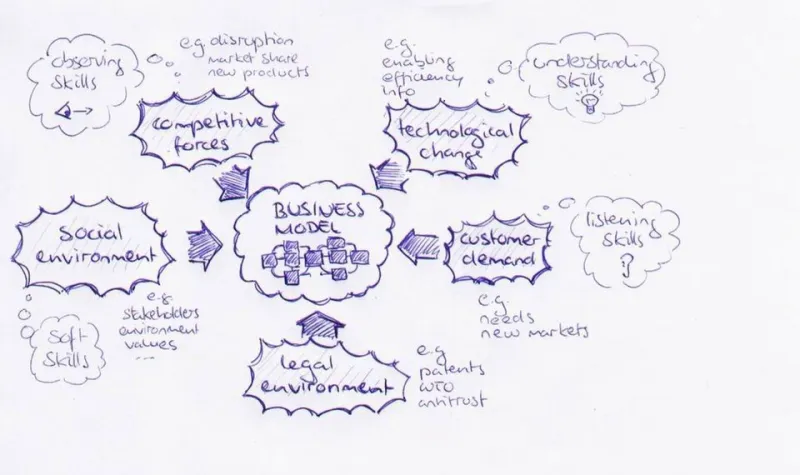
Photo: Alexander Osterwalder, CC BY-SA 2.0, via Wikimedia Commons
Every quarter, strategy teams across corporate America walk into boardrooms carrying competitive analyses. Market share breakdowns. Pricing comparisons. Competitor product capability matrices. Benchmarks measuring organizational performance against industry peers. These documents carry the weight of objectivity—they are data, after all, not opinion.
What those documents frequently do not carry is a timestamp. And that absence is costing organizations far more than most leadership teams recognize.
The Freshness Problem in Enterprise Analytics
Competitive intelligence has always been difficult to obtain and expensive to maintain. This is not a new challenge. What is new is the degree to which stale competitive data has become embedded in enterprise analytics infrastructure—treated not as a snapshot from a specific moment in time, but as an ongoing representation of current market reality.
Consider how competitive benchmarks typically enter an organization's BI environment. A strategy team commissions an industry report from a research firm. The data is ingested into a data warehouse. It is connected to dashboards and planning models. It informs resource allocation decisions, pricing strategies, and product roadmaps. And then, because the underlying data is not tagged with freshness metadata and no one has built an expiration mechanism into the pipeline, it sits there. Months pass. A year passes. The competitive landscape shifts—a major competitor pivots its pricing model, a new entrant captures significant market share, an incumbent exits a product category—and the analytics environment reflects none of it.
The organization continues making decisions against a market that no longer exists.
How Stale Data Becomes Strategic Dogma
The mechanism by which outdated intelligence becomes entrenched is worth examining carefully, because it is not simply a matter of negligence. It is a structural problem rooted in how competitive data flows through organizations.
First, competitive benchmarks are typically acquired at significant cost—from research firms, industry associations, or specialized data vendors. Having paid for the data, organizations are understandably reluctant to treat it as perishable. The investment creates a psychological anchor that discourages reassessment.
Second, competitive data rarely arrives with clear provenance metadata. When a benchmark figure appears in a BI dashboard, it is typically presented without indicating when the underlying survey was conducted, what sample it was drawn from, or what methodology was used. Users who encounter the figure have no mechanism for evaluating its currency. They accept it as current because nothing in the interface suggests otherwise.
Third, competitive intelligence often enters organizational consciousness through presentations and strategy documents before it reaches formal analytics systems. By the time it is embedded in a BI environment, it has already been cited in board materials, referenced in planning conversations, and absorbed into organizational assumptions. Updating it requires not just a data refresh but a willingness to revisit conclusions that have already shaped decisions.
The Compounding Cost of Competitive Lag
In stable, slow-moving industries, competitive lag is a manageable problem. In the market environment US enterprises currently navigate—characterized by rapid technological disruption, shifting consumer behavior, and compressed competitive cycles—it is a strategic liability.
Organizations that benchmark their pricing against competitor data from eighteen months ago may be systematically underpricing or overpricing relative to current market norms. Those that assess their product capabilities against competitor feature sets that predate a major platform launch are making investment decisions based on a competitive gap that may no longer exist—or may have widened significantly. Strategy teams that evaluate market share using figures from a pre-disruption period are measuring performance against a baseline that the market itself has already abandoned.
The decisions made on this foundation are not obviously wrong. They are wrong in ways that become apparent only later, when the gap between strategic assumption and market reality becomes too wide to ignore.
Building a Framework for Real-Time Competitive Intelligence
Addressing this problem requires both technical and organizational changes. The goal is not perfect real-time competitive data—that does not exist. The goal is a system that makes the freshness of competitive intelligence visible, auditable, and actionable.
Freshness tagging as a governance standard. Every competitive data asset in your BI environment should carry metadata indicating its collection date, its source, its update frequency, and an explicit expiration flag. When data crosses a defined age threshold without being refreshed, it should be visually flagged in dashboards—not suppressed, but marked as requiring verification before use in active decisions.
Tiered intelligence architecture. Not all competitive data ages at the same rate. Competitor pricing data may become stale within weeks in a dynamic market. Industry-level structural data—market size estimates, regulatory frameworks, long-term demand trends—may remain valid for considerably longer. Building a tiered system that applies different freshness standards to different data categories allows organizations to allocate intelligence resources efficiently.
Continuous signal sourcing alongside periodic deep research. Traditional competitive intelligence relies heavily on periodic reports—annual studies, quarterly analyst briefings, commissioned benchmarking exercises. These remain valuable but insufficient as a sole source. Organizations should supplement them with continuous signal monitoring: tracking competitor job postings, patent filings, pricing page changes, product release notes, and earnings call transcripts in near real-time. These signals do not replace structured research, but they surface inflection points between research cycles.
Competitive data stewardship as a formal role. Treating competitive intelligence as a living data asset—rather than a static document—requires human accountability. Assigning explicit ownership over competitive data domains, with defined responsibilities for monitoring freshness and triggering refresh cycles, transforms competitive intelligence from a one-time deliverable into an ongoing operational function.
The Strategic Imperative
The organizations that consistently outperform their peers are not necessarily those with the largest strategy teams or the most sophisticated planning processes. They are the ones whose decisions are grounded in an accurate understanding of the competitive environment as it currently exists—not as it existed when the last research report was commissioned.
Building that capability requires treating competitive intelligence with the same rigor, governance, and freshness standards applied to any other critical data asset in the enterprise. The alternative is a strategy function that is perpetually—and invisibly—operating on yesterday's information.